
Étiquettes
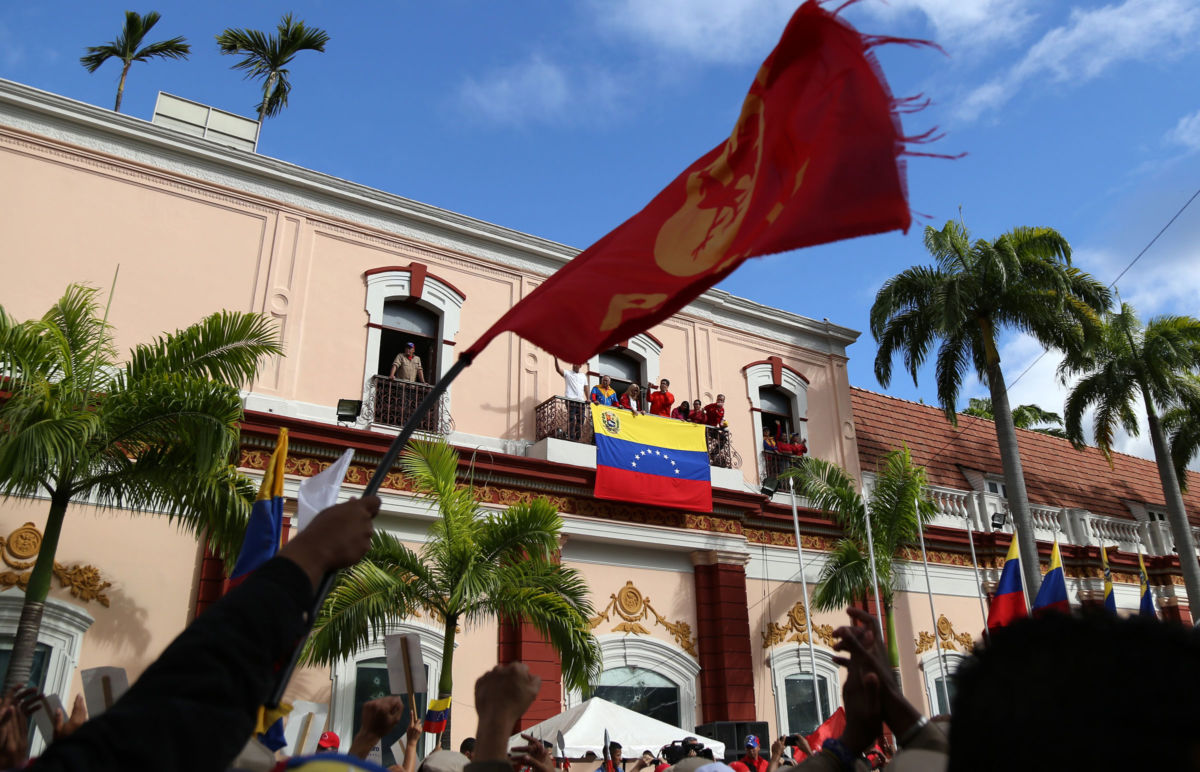
The latest US-backed effort at regime change in Latin America took shape Wednesday when a nearly unknown Venezuelan opposition politician named Juan Guaido declared himself the interim president of the country at a rally in the capital city of Caracas.
In quick succession, the United States — along with a number of right-wing governments in the region including Colombia, Brazil and Chile — declared that it would recognize Guaido as president. Meanwhile, global mainstream media coverage depicted the event as the restoration of democracy in the South American country, with outlets making only a passing mention of the large pro-government demonstration that also took place.
Addressing a large crowd of supporters who had gathered at the presidential palace in the Venezuelan capital, President Nicolás Maduro condemned the attempted coup and announced that his government would break diplomatic relations with the United States in response.
According to Jorge Martin, a spokesman for the Hands Off Venezuela campaign based in the United Kingdom, which works to build public support for the political revolution in Venezuela, Wednesday’s coup attempt was but the latest in a long series of efforts by successive US administrations to oust the government in Venezuela.
“This is a long, protracted plan to get rid of a government that is not compliant with the foreign policy of Washington,” Martin told Truthout.
Relations between Venezuela and the United States have been strained since the arrival of Maduro’s predecessor, Hugo Chavez, to the presidency in 1999 on a promise to confront the country’s old political class and redistribute Venezuela’s oil wealth to the poor. Chavez’s rise to power marked the beginning of what came to be known as the “pink tide,” in which numerous countries throughout Latin America broke free from the influence of Washington and elected leftist governments that sought to combat inequality, make social investments and address rampant poverty.
According to Martin, there has been no shortage of efforts by the United States and the Venezuelan opposition to oust the government over the years, such as the sabotage of elections, diplomatic pressure, economic sanctions and even a short-lived military coup in 2002 that saw Chavez briefly ousted before mass mobilization saw him returned to power.
However, a protracted economic crisis in Venezuela — spurred on by a drop in the price of oil, the country’s number one export and key source of income — has weakened domestic support for the Maduro government, damaged his image abroad, and has provided Washington and the Venezuelan opposition with an opening to attempt to remove Maduro from power.
The Trump administration in the United States has also been keen to oust Maduro by any means necessary, with Trump openly flirting with the idea of a US-led military intervention in Venezuela.
“What we’re seeing now had been planned, in detail, at the very least since the beginning of this year,” said Martin.
The seeds of the coup attempt were planted earlier this month when the countries that make up the so-called Lima Group refused to recognize Maduro’s second term. The Lima Group is an ad-hoc group of countries formed to facilitate the ouster of Maduro after numerous failed attempts to have the Organization of American States formally condemn the Maduro government.
“It is not by chance that Guaido appointed himself and then immediately the US, Brazil, Colombia and other countries recognized him,” Martin told Truthout. “It is the other way around; they pushed him toward appointing himself as president, all part of a pre-established plan.”
 Groupe Gaulliste Sceaux