
Étiquettes
“Democratic candidates used to be proud to stand alongside Israel, and AIPAC,” said Republican Senate Majority Leader Mitch McConnell at the recent gathering of the American Israel Public Affairs Committee (AIPAC). “Now some are jockeying to see who can get the farthest away.”
McConnell was referring to Sen. Bernie Sanders, who denounced the pro-Israel lobby for providing a platform “for leaders who express bigotry and oppose basic Palestinian rights” when he announced on February 23 that he would not be attending the annual conference.
Sanders’s move was very significant, but he was not alone. Former Democratic candidate Sen. Elizabeth Warren had first announced she would skip the conference earlier in February. After Sanders’s announcement, something remarkable happened — fellow Democratic candidates Sen. Amy Klobuchar and former South Bend, Indiana, Mayor Pete Buttigieg, who are far more moderate and typically pro-Israel in their politics, announced they would also skip the conference (before ending their presidential bids before Super Tuesday, at any rate).
The announcements represent a stark departure from the path that presidential candidates have followed year after year in pursuit of the Democratic Party nomination, and they came after years of activist pressure. To a significant extent, the recent turn of events highlights how the erosion of Washington’s bipartisan consensus is accelerating under the Trump administration — ultimately opening space for a more progressive politics on Israel-Palestine.
The “Deal of the Century”
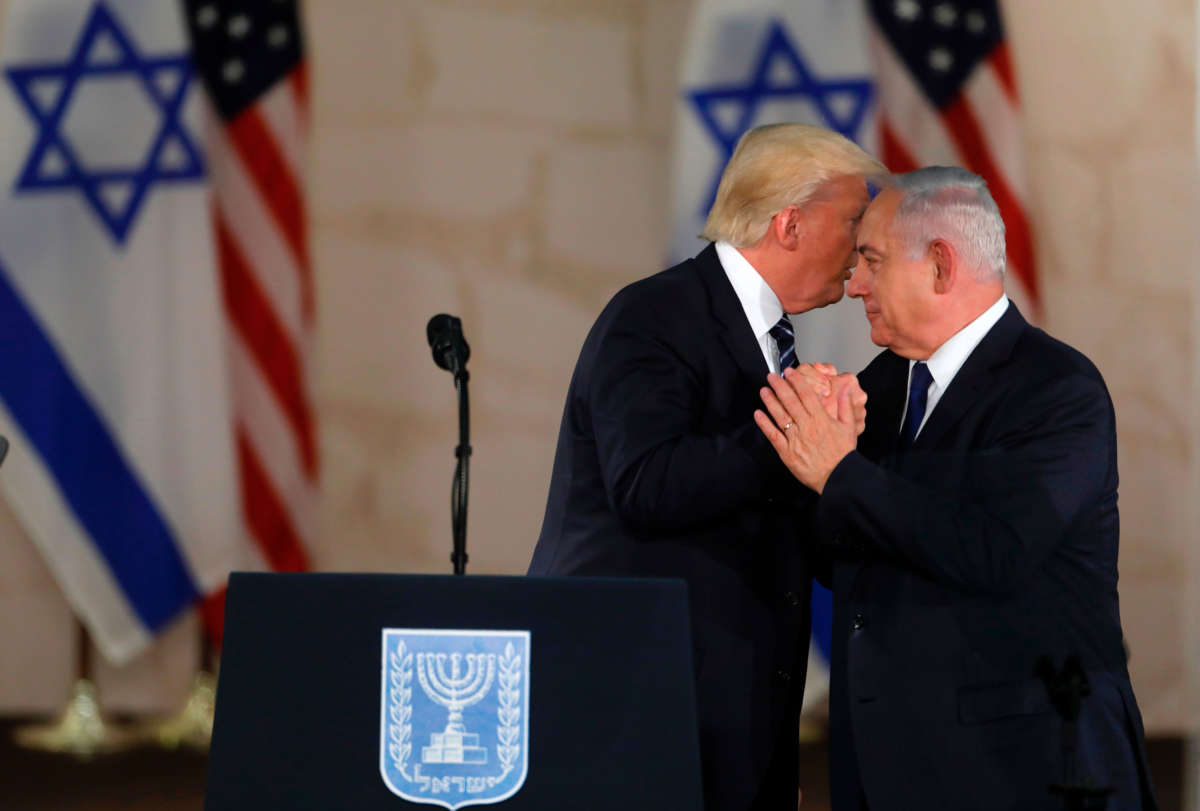
Standing alongside President Trump as he unveiled his so-called “deal of the century” for Israel-Palestine, Israeli Prime Minister Benjamin Netanyahu turned to Trump and said, “You have been the greatest friend that Israel has ever had in the White House,” to thunderous applause.
It is easy to see why Netanyahu felt sentimental. When asked during a CNN interview to respond to the notion that Trump’s plan skews toward Israel, Palestinian legal scholar Noura Erakat said, “I think that that’s an understatement. It doesn’t tilt toward Israel. It’s an Israeli plan.”
The plan — which was negotiated by Americans and Israelis, with some participation from Arab states like Saudi Arabia, Bahrain and Oman, but no Palestinians — offers Israel complete control of Jerusalem. It allows for illegal Israeli settlements in the West Bank to remain. It presents the Jordan Valley, in the West Bank, as Israeli territory.
As Yousef Munayyer of the U.S. Campaign for Palestinian Rights has pointed out, the plan offers Palestinians only “a truncated and dismembered archipelago of Bantustans connected by bridges and tunnels and subservient to the Israeli state.” In fact, many have compared the vision for Palestinians laid out in Trump’s plan to the Black homelands of Apartheid-era South Africa.
It is no wonder, then, why Palestinians have decried the plan. Munayyer called it not a peace plan but a “war plan” that declares “war on Palestinian existence.”
But there is also reason to believe that Trump’s plan may do some long-term damage to his “friend” in the state of Israel. Rather than the Trump years being remembered as the “Golden Age” of the U.S.-Israeli relationship, they may very well be seen as the turning point that began its decline.
 Groupe Gaulliste Sceaux