
Étiquettes
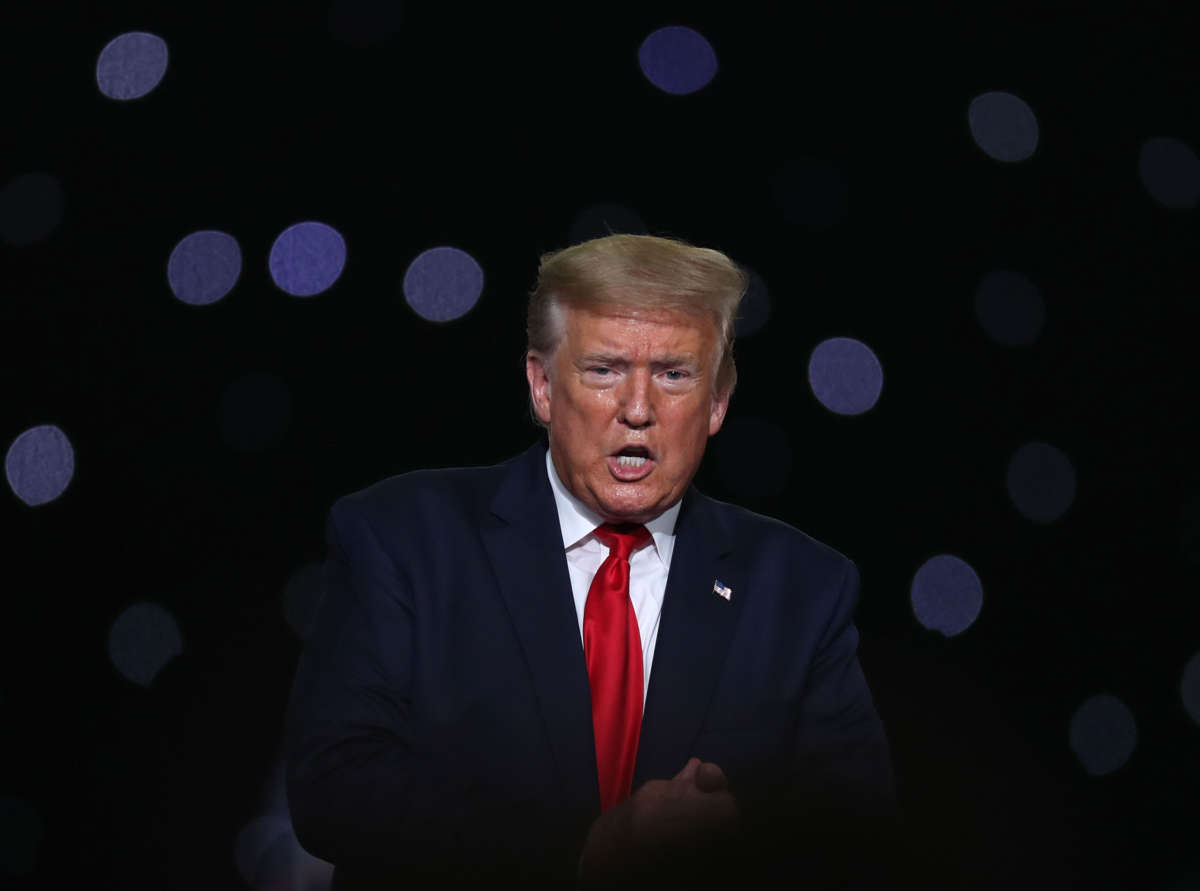
Many years ago, social scientist Bertram Gross saw “friendly fascism” — an insidious authoritarianism that denies democratic rights for corporate ends without the overt appearance of dictatorship — as a possible political future of the United States.
Today, that future has arrived. Donald Trump has not only consolidated the integration between Big Business and government, but now, with the country in the grip of some of the biggest protests in more than half a century, he is actually trying to turn the U.S. into a police state, to “‘dominate’ by violence and terrify any potential opposition,” as Noam Chomsky astutely points out in a new and exclusive interview for Truthout.
C.J. Polychroniou: Noam, for the past 40 or so years, we have been witnessing in the U.S. the demolition of the welfare state and the supremacy of the ideology of market fundamentalism to the point that the country is unable to deal with a major health crisis, let alone resolve long-standing issues like large-scale poverty, immense economic inequalities, racism and police brutality. Yet, Donald Trump did not hesitate in the midst of the George Floyd protests to declare that, “America is the greatest country in the world,” while he is seeking at one and the same time to start a new civil war in this country through tactics of extreme polarization. Can you comment on the above observations?
It’s routine. He’s a radically new phenomenon in American political history.
Another Trump reflex is his call for “the most vicious dogs, and most ominous weapons, I have ever seen” when peaceful protesters appear near his abode. The phrase “vicious dogs” evokes the country’s horror when images of vicious dogs attacking Black demonstrators appeared on the front pages during the civil rights movement. Trump’s use of the phrase was either by intent, to stir up racist violence, or reflexive, arising from his innermost sentiments. I leave it to others to judge which is worse, and what either tells us about the malignancy at the center of global power.
With that qualification, there is no inconsistency. Both the claim that America is the greatest country in the world, in his special sense, and his call for domination, follow from his guiding doctrine: ME!
A direct corollary to the doctrine is that he must satisfy the demands of extreme wealth and corporate power, which tolerate his antics only insofar as he serves their interests abjectly, as he does with admirable consistency in his legislative programs and executive decisions, such as the recent Environmental Protection Agency decision to increase air pollution “in the midst of an unprecedented respiratory pandemic,” risking tens of thousands of deaths, disproportionately Black, the business press reports, but increasing wealth for those who matter.
The success of his tactics was revealed clearly at the January extravaganza at the Davos ski resort, where the masters of the universe, as they are called, meet annually to cavort and congratulate one another. This year’s meeting departed from the norm. There was visible concern about “reputational risk” — recognition that the peasants are coming with their pitchforks. Therefore, there were solemn declarations that, We realize we’ve made mistakes, but we are changing, you can put your faith in us, we will become “soulful corporations,” to borrow the phrase used in accolades to corporate America in the ‘50s.
The keynote address was, of course, handed to Trump, the Godfather. The elegant figures assembled don’t like him. His vulgarity and general brutishness disrupt their preferred image of enlightened humanism. But they gave him rousing applause. Antics aside, he made clear that he understands the bottom line: which pockets have to be stuffed lavishly with more dollars.
Another direct corollary of the guiding doctrine is that the con man in charge must control his voting base while he is stabbing most of them in the back with his actual programs — a difficult feat, which he has so far carried off with much skill. The voting base includes not only avid white supremacists but others in the grip of the fear of “them” that is a core part of the culture — and is of course not without foundation. One consequence of bitter repression is that “they” often resort to crime — that is, the retail crime of the weak, not the wholesale crime of the powerful.
For Trump’s prime constituency of great wealth and corporate power, America is indeed the greatest country in the world. How can one fault a country in which 0.1 percent of the population hold 20 percent of the wealth while the majority try to survive from paycheck to paycheck and CEO compensation has reached 287 times that of workers? And calls for domination by vicious dogs placates much of the voting base.
So, all falls into place.
The actor George Clooney responded with an essay for the Daily Beast to the killing of George Floyd by saying that racism is America’s pandemic, “and in 400 years we’ve yet to find a vaccine.” Why is racism so entrenched and intractable in the United States?
The answer is given by what happened in those 400 years. It’s been reviewed before, but for me at least it’s useful to take a few minutes to think it through again until it becomes deeply ingrained in consciousness. In summary:
The first 250 years created the most vicious system of slavery in human history once the colonies had gained their liberty, the foundation of much of the nation’s wealth. It was unique not only in hideous cruelty but also in that it was based on skin color. That is ineradicable, a curse reaching to future generations. Other minorities were brutally treated, even barred from the country by racist laws (Jews and Italians, the prime target of the 1924 immigration law, which lasted for 40 years, long enough to condemn European Jews to crematoria, and post-war, to ensure that survivors went to Palestine, whatever they might have preferred). But the stigma was not permanent. They could be assimilated and turn to more “acceptable” professions than running Murder, Inc.
Also unique is the fervor of American racism. The “one drop of blood” criterion for the U.S. anti-miscegenation laws that remained on the books until the civil rights movement of the 1960s was so severe that the Nazis rejected it when they were searching for a model for the racist Nuremberg laws — though they did appeal to the American precedent as the only one they could find.
 Groupe Gaulliste Sceaux